
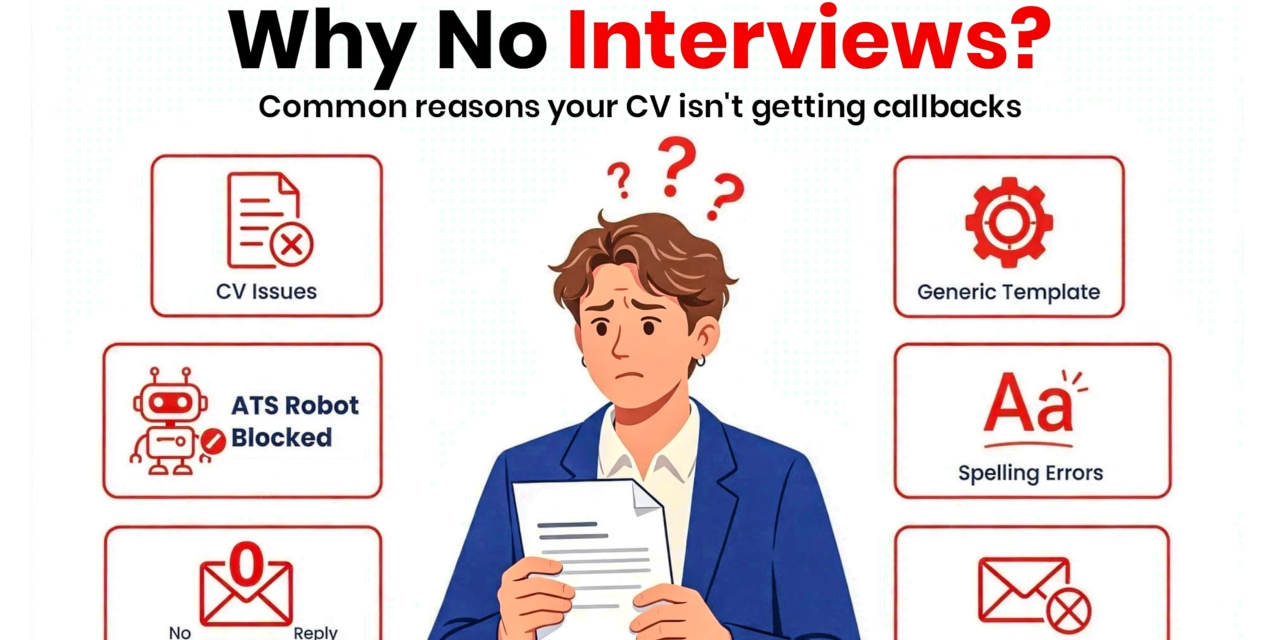
Currently, the question running through your could be Why your CV is not getting you interview? You saw the work advert. You read the job requirements. You submitted your CV. Day one. Day two. You’ve refreshed your email, hoping to be called for an interview still, nothing.
You applied again with that same CV. You waited. And waited. Still, no response. You blame yourself. Your village people should probably be at fault.
Here’s the real talk: You’re not the problem. If anything is stopping you from getting interviews in 2026, it’s your CV. Your CV isn’t communicating what you do quickly enough.
RECOMMENDED FOR YOU: How To Build A Professional CV That Gets You Hired Faster
In this article, I will explain why it keeps happening and what you can do to fix it.
20 Reasons Why Your CV is Not Getting You An Interview
1. You’re using the same CV for every job
Every company is different, and every job is unique.
If you must send your CV to any organisation, it must align with what they’re looking for. If it’s not, you’re making a big mistake.
2. Your CV has no personality
Your CV should be formal, but it should also reflect a small sense of who you truly are.
You don’t want to sound like every Tom, Dick, and Harry.
3. Your CV is not ATS-friendly
An ATS (Applicant Tracking System) is software companies use to scan CVs.
If your CV gets rejected, it was the ATS. Avoid using many designs or tables in your CV, as the system won’t read it correctly.
4. You didn’t explain job gaps
This is one of the common reasons you don’t get called for interviews.
If you were unemployed for some time, leaving a blank space without explanation won’t get you anywhere.
5. You’re listing duties, not achievements
Nobody cares about how you carried out your tasks, because what matters is what you achieved.
If you say, “I write stories on Wattpad,” you should show what results it yielded in your CV.
RECOMMENDED FOR YOU: 15 Common Job Interview Questions and Best Answers for 2026
6. You copied everything from ChatGPT or a template
If you’ve never been invited for an interview, this is one of the reasons. AI is good, but avoid overusing it to write your CV. Be original. Let your words be true.
7. It has no proof
Avoid using clichés like “I’m hardworking” or “I’m a team player.” Everyone uses that. To stand out, your CV has to be creatively drafted.
8. You added things that don’t matter
Nobody is interested in your age or your relationship status.
Recruiters want to know what you’re bringing to the table. Avoid listing the many hobbies you have or the courses you took.
9. You don’t have the right keywords
If the job requirements say they need someone with “social media management skills” or “web design experience,” and it’s not matched with your CV, you can’t be called up for interviews.
10. You don’t mention results with numbers
This is very simple and important. Saying, “I improved sales” is too dull.
It’s not specific enough. Recruiters want to know how much you improved sales, and the outcome after the sales.
RECOMMENDED FOR YOU: How to Optimize Your LinkedIn Profile for Job Opportunities
11. The format of your CV is confusing
Once your CV isn’t clear, clean, and organized, you have already lost your chances of getting an interview.
Your CV has to be accurately formatted, because recruiters spend 6 seconds to be impressed as they scan a CV.
12. You added too much personal information
Avoid including too many personal details such as religion, a photograph, or your full home address (unless the job or country requires it).
13. There are typos or grammar mistakes
This is a big deal. It still happens.
One single grammatical blunder can hinder you from getting an interview. Therefore, when you want to draft your CV, you must pay attention.
14. You left out contact details
When writing your CV, you need to add your current phone number, your email, and your current home address.
This could hold you back if you don’t include your contact information.
15. Your CV is too long or too short
The minimum length of your CV should be 2 pages.
Therefore, if your CV feels rushed or it’s four to five pages, with bulky information, then you’re likely to be rejected.
16. You’re using an uncommon file format
If you submit your CV as a Google Docs link or Pages file, some recruiters may not be able to open it. And if you send a screenshot of your CV, it simply means you’re out before you start.
Always save and submit your CV as a PDF unless the employer specifically requests a Word document (.docx)
17. You’re applying too late
The longer you wait, the slimmer your chances of getting an interview.
Every day, people apply for jobs, and once the deadline has passed or the slots are filled, you’re likely to receive a rejection email.
18. Your file name looks unprofessional
This is a common reason why your CV hasn’t gone far. Your CV must be named professionally, so that it can leave a long-lasting impression.
If your CV file name is “CVlastfinalfinal(20),” it won’t be easy to track. It is most advisable to save your CV with your full name so it can be easily tracked.
19. You’re applying for roles you’re not qualified for
It’s great to think big.
But if you keep applying for jobs where the requirements are beyond your skill level, employers might scroll past.
The least you can do is make sure your CV matches 70% of the job before applying.
20. Your CV has no clear structure
For instance, a CV that starts with hobbies, work experience, education, then back to hobbies, is going to be skipped.
Employers want to find things fast and easily, but if your CV is jumping all over the place, you will not get that interview.
Bonus point: When applying for a role, read the job description carefully.
Some employers specify what you should use as the subject of your email. If it’s not stated, use the role you’re applying for, e.g., “Social Media Manager Application” instead of “Job Application”.
RECOMMENDED FOR YOU: 10 Easy and New Skills to Learn for Free and Use to Make Money
How To Make Your CV More Interview-Worthy
Start with a summary at the top
After writing your name and contact details at the top section of your CV, the next step is to write a summary of who you are and what you do.
Three to four lines that include your job title, important skills, and the value you bring are enough for the introduction.
Use the same words that appear in the job post
Always read the job requirements carefully before submitting your CV.
Using the right keywords matters, because it will help the recruiters/computer recognize it on time.
If the company is looking for an individual with “bookkeeping experience,” make sure those words appear in your CV, so that they can be certain you’re a great fit.
Show what you achieved, not just what you did
For instance, instead of writing “handled social media,” you can say, “Managed the organization’s Twitter and Facebook account pages, increasing the followers by 50% in three months.”
Always include numbers or results when drafting your CV, because it will make you believable.
Keep your formatting clean and simple
You don’t need many colours or designs on your CV.
Use basic fonts like Arial or Calibri; use size 10 or 12. Use bold text only for headings, e.g., skills, education, work experience, etc. Avoid using columns or icons, because they confuse the ATS and might cause your CV to be rejected.
Focus on your most relevant experiences. Proofread your CV. Add accurate contact details. Use tools to assist in improving your CV, such as Grammarly, Rezi, Resume Worded, etc. Don’t forget to tailor your CV for each job.
RECOMMENDED FOR YOU: How to Optimize Your LinkedIn Profile for Job Opportunities
Why Your CV Is Not Getting You Interviews FAQs and What You Should Know
What if I don’t have much experience?
Whether you’re a recent graduate, a student, or you’re switching careers, you can still create a strong CV that includes relevant internships, academic projects, volunteer work, personal projects, etc. They’re all experiences.
Should I follow up after submitting my CV?
A follow-up is fine. After waiting for at least a week, you can send a short and polite message, mentioning the role you applied for, the date, and your continued interest.
What’s the best file type for submitting a CV?
Always use PDF, because it keeps your CV intact, while a Word Doc (doc. or docx) can appear different. Only use Google Docs links except when specifically requested.
Should I create a different CV for every job?
You don’t necessarily need to rewrite your CV every time. What matters is tailoring your CV to the job requirements, so that your application can be targeted.
Wrapping Up on Why Your CV Is Not Getting You Interviews
Now you know why your CV has been ignored. You also know how to make it work. Return to your CV.
Remove every unnecessary piece of information. Change the font. Use the accurate keywords. Clean up the format. Add real results. Read it aloud.
Then, submit your CV again. This time, with the intention of being called for an interview.
While you anticipate responses, don’t fold your arms. Keep sending out your application. Keep growing. Keep showing up.
Feel free to follow Skill4Today on X (Twitter), Facebook, and WhatsApp Channel to stay updated on the latest trends on career tips, free online courses, interview success tips, and job hunting.