
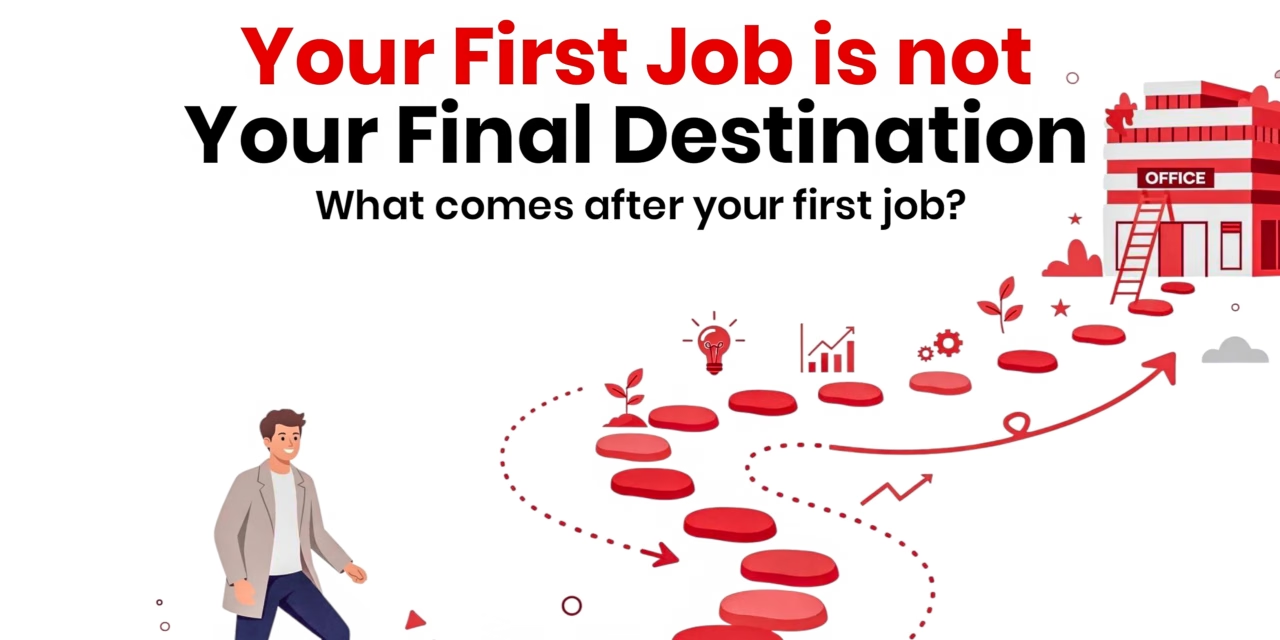
Your first job can feel like “this is it.” This is your final bus stop.It’s okay. It’s absolutely normal. After months of applications, rejection emails, and “we will get back to you” responses.
That “Congratulations. You’ve been selected” won’t stop ringing in your head. Friends and family won’t breathe. Instagram will not rest. TikTok sef must collect.
A few months later, reality opens the door and enters itself. You’re not excited anymore. Your salary is just not enough. Your boss isn’t nice at all. You begin to wonder whether you’re building a career or just working year in, year out.
If you’re in these shoes, all hope is not lost. Your first job doesn’t have to be your forever job. In this article, you will understand why and what you should do instead.
READ ALSO: 15 Common Job Interview Questions and Best Answers for 2026
Let’s set the ball rolling.
Your First Job Doesn’t Have To Be Your Final Career (Here’s Why)
Your first job is a starting point
Getting your first job isn’t the same as choosing a career. That opportunity or internship matters, but it’s not the end. It’s not even the beginning of a perfect career, because your first job is meant to teach you what you want next.
This is why there are entry-level roles for students and fresh graduates. Therefore, your first job can simply be your first job.
You might discover things as you start working
For instance, you join a sales and marketing team, and you realise you enjoy talking to customers and solving their problems. Or you begin as a video editor, and eventually move towards video animation.
None of these paths are failures, but discoveries. That’s why it’s a first.
Your first job should give you something
This is where most people miss it. They believe doing any job doesn’t matter, but it actually does.
Your first role should give you something that would push you forward, such as skills, real projects, a professional network, etc.
It can even be a clear understanding of what you want and what you don’t. All of these count.
RECOMMENDED FOR YOU: How to Optimize Your LinkedIn Profile for Job Opportunities
Don’t chase the perfect first job
There’s no perfect career. Every job has its ups and downs.
Imagine you get an offer that pays slightly more, but gives you very little opportunity to learn, and there’s another that pays less, but gives you meaningful projects, seasoned teammates, and industry exposure you’re interested in. Which would you go for?
If you understand, it means your first job is also an investment in your next opportunity.
Your career doesn’t have to be a straight line
Society has made us believe that after getting a degree, you would get a job, become promoted to a senior role, and eventually become a CEO. All of which rarely happens.
You can switch companies, learn new things, or start all over again. Your career journey doesn’t have to be on a straight line, because change is constant.
The goal isn’t to predict what to do next, but for every step to leave you with something useful.
Your First Job Doesn’t Have To Be Your Final Destination (Here’s What You Should Do Instead)
Build skills outside your job
If you’re passionate about another field, don’t waste too much time overthinking it when you can gradually take online courses, read books, volunteer, create content around it, build portfolios, get mentorship, etc.
You don’t need to quit your current job to achieve this. As you earn from your first job, you’re investing in your next career.
RECOMMENDED FOR YOU: 10 Easy and New Skills to Learn for Free and Use to Make Money
Keep a record of what you accomplished
This is where most people get stuck. You don’t need to wait until you’re applying for another job before you remember what you’ve done at your current workplace.
Document your achievements. Keep clear records of how you were able to achieve certain feats.
Instead of “Shot two videos today,” write “Shot a cinematic video for a traditional wedding that got 500 followers on Instagram.”
Build relationships, not just contacts
Your first workplace can connect you to individuals who can influence your career.
Your colleague can recommend you. Your boss can become your professional reference. A client can remember your work.
All in all, treat everyone nicely. Help when you can. Learn what you need. Communicate well.
You don’t need a long list of contacts; you only need meaningful relationships.
Don’t chase job titles—build career capital
You don’t want to become someone who spent three years collecting job titles but can’t explain exactly what they achieved.
Career capital is lifetime experience that can make your next job opportunity easier and faster to pursue. They include skills, experience, relationships, knowledge, etc.
Therefore, focus on becoming a valuable person, rather than simply collecting fancy job positions with nothing to show.
Know when it’s time to move
Don’t spend forever on your first job, because you’re afraid to leave.
It may be time to explore other job opportunities when your career goals have changed, your skills have outgrown your current post, your job no longer matches where you’re headed, etc.
Before you leave your current job, update your CV, build your portfolio, save some money, improve your skills, strengthen your relationships, then take that bold step onto the next.
READ ALSO: How To Build A Professional CV That Gets You Hired Faster
FAQs About Your First Job And Career Growth
So what should I actually look for in my first job?
What you should look for when evaluating your first opportunity is whether you will learn something useful, real, and explainable, whether you will have people you can learn from, and whether the experience can open doors.
What if I don’t know what I want yet?
That’s not a problem. You can begin by asking yourself questions like, “What do you want to learn?” “What are you interested in?” “What skills would make you more valuable?” etc. You don’t need to have everything figured out because clarity comes from action.
What’s the biggest mistake I can make in my first job?
The biggest mistake you can make is letting your first job convince you that you don’t have options. Your first salary isn’t your final salary. Your first professional identity doesn’t have to be permanent. You have the right to evolve.
Is it normal to dislike your first job?
Yes. Your first job might reveal that the role or career path isn’t right for you. But give yourself time to distinguish between temporary difficulties and permanent misalignment.
Should I quit my first job if I don’t like it?
You don’t necessarily have to. Before quitting your first job, you need to know and understand why you dislike it and whether the problem can be solved.
Final Thoughts: Your First Job Is A Chapter. Not A Whole Book
You don’t need to have everything figured out before receiving your first offer letter. All you need is to start.
Learn new things. Travel. Make mistakes. Notice what you enjoy and what you’re not good at. Build experience. Invest in your relationships.
Then, take your next step with more information than you had in the past, because that’s what a career is actually all about. It’s a series of decisions made with the right information.
Your first job doesn’t have to be your dream job. It doesn’t have to be perfect. It just needs to help you make the right move at the right time to the right place and with the right people.
Feel free to follow Skill4Today on X (Twitter), Facebook, and WhatsApp Channel to stay updated on the latest trends on career tips, free online courses, interview success tips, and job hunting.